
17th Apr 2023
When I first read this client origin story from the founders of Thinking Outside, I could feel their energy bouncing through their words. Here they are with a refreshing, effective, important and frankly fun sounding way to do things differently...
Hello. We’re Sophie Lovejoy and Sara Corcoran from Thinking Outside Ltd, and we passionately believe that you and your team would do well to get out more.
 Do you dread team days? Stuck inside a meeting room all day and often not covering the topics that really need to be discussed, do they really deliver what businesses need? Often the louder voices dominate the conversation, and it can be harder to engage the full breadth of ideas and experience present. Many people feel uncomfortable talking in this setting and dread being asked to contribute, preferring to keep quiet.
There is growing evidence that taking your thinking outside in nature gives better and longer-lasting results than traditional team events. More and more businesses are adopting this approach and seeing an increase in productivity, creativity and wellbeing as a result.
Thinking Outside clients talk about the richer and deeper conversations that are possible walking side by side and how the use of outdoor spaces results in deeper relationship building and more innovative thinking. What we do is especially relevant to the post covid world, building strong relationships across members of teams who spend much of their time interacting through their screens.
As well as providing team days – clients find our approach particularly effective for teams that aren’t running as smoothly as they might like – we can support with formulating strategy, developing a vision or reimagining a process. Our events are designed to be inclusive so all members of your team can be equally heard and involved. What we don’t do is outward bound-style challenges… we walk, talk, build connections and get commitment to action.
Our office can be field, forest, riverside, hill or park. In fact anywhere that works for our clients.
We have known each other for over 20 years and both have a focus on developing teams and individuals, despite having done different things throughout our careers.
Sara has a background in Organisational Development (OD) and HR so making workplaces the best they can be and developing organisations, teams and individuals has long been at the heart of her purpose. After a career culminating as Director of HR and OD helping to establish a new university, Sara qualified in 2020 as a Coach and established a private practice, working with Senior Executives and their teams.
Sophie has had a portfolio career and alongside her OD work in and with universities, she has done a range of things, from running rocket car workshops in schools for Bloodhound Education, to managing a café at a music festival for a few years. She’s also conducted over three hundred funerals in two decades working as an independent Humanist celebrant.
When Sara was introduced to the concept of coaching “in and with nature”, they soon discovered that this way of working played to both their strengths. This led to a conversation in early 2021 about working together and the creation of Thinking Outside.
Since then, we have worked in various locations across the UK with clients from a variety of sectors. In every case, we’ve found that getting teams and groups to take their thinking outside has deep and lasting results. An added bonus is that we reckon that happens around three times as quickly as we could achieve inside a meeting room. Our clients tell us that working in this way is hugely beneficial, and even the most sceptical of attendees have become converts to our approach. In fact, sometimes they become our biggest advocates and want to know when we’ll be working with them again!
Our passion and purpose is about helping teams and organisations develop and meet their goals alongside enjoying, appreciating and nurturing our natural world, having a heap of fun along the way. We still can’t believe how lucky we are to wear hiking boots to work!
Find Thinking Outside online:
Website: thinking-outside.co.uk
Instagram: instagram.com/thinkingout2021
LinkedIn: linkedin.com/company/thinking-outside-ltd
Facebook: facebook.com/ThinkingOut2021
5th Apr 2023
Last May we shared how we are focussing our efforts on supporting clean energy and nature, in addition to what we do via our core services and business practice. Nearly a year on we feel that these issues are just as important as ever, if not more. So here's an update on how we are expanding on what we already do and the causes and organisations we are backing.
 It is now commonly understood that access to green spaces positively affects our wellbeing. Better still, real connection, such as conservation activities and growing food and flowers in harmony with nature brings a whole new level of understanding about the natural world and our place in it.
Keep nature healthy = keep ourselves healthy.
I (Vic) am a keen nature lover. I garden at home and I spend time walking with our dog in various natural environments. Additionally, over the past few years I have been involved in local urban community gardens and gardening. I know how fortunate I am and I know all too well that there are many people who do not have this kind of access to nature. On top of this, nature is being threatened by harmful legislation, corporates prioritising profit over the planet and the continuation of destructive developments like HS2.
There are individuals and organisations everywhere who are experts in nature conservation and organic food growing, particularly the unsung heroes in inner-city community gardens. Here you will find a wealth of knowledge and experience that anyone can tap into for free, not to mention a fierce passion for the environment and a deep care for people and their access to healthy food and time outdoors. On a wider scale there are regional and national charities working hard to shine a light on eco injustices and tackling them head on. These are the people we look to for guidance on how best to support.
So below, is an outline of where we are focussing our support this year and will review again next year to see what is effective, how we can best help and more we can do in our capacity as a small business.
The food system is quite broken. Out of season fruit and veg are flown thousands of miles to be packaged and then to a supermarket shelf. Soils are massively depleted, harmful chemicals are sprayed on crops and bees are farmed at industrial levels to pollinate fruit grown in unnatural environments. At a time when people are going hungry, there needs to be more accessible, affordable food that isn't just healthier for the people but for the planet too.
Current renewable energy solutions may not be perfect but we believe we should continue to support it's growth.
Through the activies listed above, we are working towards Sustainable Development Goal 15 'Life on Land'. See our Impact page for details about the sustainable development goals we focus on.
31st Mar 2023
 The UK's biggest online craft fair, Folksy has launched a new directory of ethical and trusted providers and we're in it!
We are delighted to be listed alongside some great suppliers and services for artists, designers and makers. You'll find us under the 'Packaging, Apps & Services' category (or scroll to the bottom).
We are offering a 20% discount to Folksy members on all of our Green Hosting plans. So if you're looking to switch web hosts or create a new website then head over to Folksy to get your discount code.
If you're not a Folksy member and you're interested in signing up to Green Hosting, we can give you a discount too. Just drop us a line.
Check out the Folksy Trusted Suppliers Directory here and see the fabulous Folksy marketplace here.
20th Mar 2023
Back in November 2019 we were looking for additional ways to continue to support clean energy via Green Hosting. We already did this by using renewable energy for our website hosting service and for our office base. We promote the use of renewable energy, design websites that run efficiently so as to consume less energy and provide information and guidance on ways others can do this too.
Next we wanted to contribute to action that was having a very direct and real impact on people who may not have access to the same resources and abundance of choice as we do. This is when we found Renewable World, a charity that tackles povery and climate change through off-grid, renewable energy solutions for low-income individuals, families and communities in remote places.
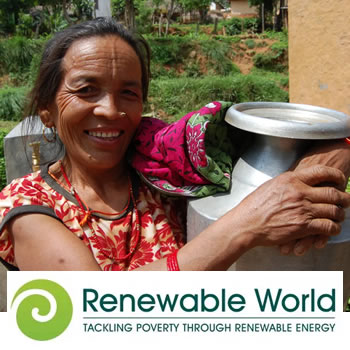 Renewable World have expert understanding and experience of how access to energy and running water impacts individuals' and communities' opportunities as well as their income, independence and health. They also know that the way to make energy and water solutions (and their positive effects) truly long-term and sustainable is to work alongside communities. This is why they do not simply install systems and leave but partner with communities to ensure they are engaged in choosing, building and maintaining their renewable energy solution. They also provide training in a range of fields including technical, financial, agricultural, business and more and ensure that those involved are equally represented across men, women, young people and marginalised groups.
Renewable World focus their support in remote areas of Nepal and Kenya, some of the most underserved communities in the world. Working with people here to develop and sustain energy and water solutions helps build resilience, brings about social change, contributes to climate justice and helps mitigate climate change. Read more on our page about Renewable World about what these energy projects mean in the every day lives of the people who use them.
Since their inception in 2008 Renewable World have reached around 110,000 people and over 150 communities. They have delivered energy solutions capable of:
- generating 1.54GWh of energy per year.
- pumping 336 million litres of water per year.
- mitigating 7524 tonnes of CO2 per year.
Their achievements can be read in detail on their Impact page and in their 2021-22 annual review. Now they have a new ambitious target of increasing access to to clean, affordable and sustainable energy for 500,000 people by the end of 2030.
In 2019 and today, this inclusive approach and impressive results meant that the work of Renewable World was something we wanted to be a part of.
We donate at least 1% of our monthly Green Hosting sales income to Renewable World each month. This money goes directly from us to the charity, without fees being taken by a third party. To date we have donated over £1300. Renewable world state that £20 per month could provide a community with agricultural training and tools, helping them increase their income by growing cash crops, and benefiting up to 500 individuals.
Here's what Renewable World said about our donations
"We are very grateful for the support that you offer us. A monthly contribution is especially valuable, much better for a healthy cash flow!"
Emily Jesshope, Fundraising and Events Manager
So, thank you to our clients who continue to choose Green Hosting. Alogside us, you are the ones who are supporting Renewable World and their wonderful work. See our Impact page to see all of the other positive things you are supporting too.
28th Feb 2023
The online world can be a wonderful place, breaking down barriers that exist in the physical and enabling us to communicate with each other far and wide.
 More so now than ever is it pertinent to make sure our website content is accessible and inclusive to the diverse range of visitors we will hopefully receive.
This is a simple guide, so we are keeping it short and sweet here but at the end of this post are links to previous, more in-depth articles we have written on the subject.
Implement these steps and you can make a big difference to your website users' experience:
This has just been a really quick guide but to delve deeper, do check out:
Reducing digital exclusion in online content creation
How to make your social media content more inclusive
Green Hosting works handsomely with:
Auto-installer now available on all accounts
